Source Snapshot
- Origin: NVIDIA Factory Operations Blueprint Gives Factories a New AI Brain and local technical deep dive source
nvidia-fox-blueprint-en.html- Published: 2026-05-31 and 2026-06-04
- Evidence level: NVIDIA and partner claims; deployment metrics require local validation before investment decisions.
- One-line takeaway: FOX is best understood as a governed factory manager agent and MOM-adjacent orchestration layer that coordinates specialized industrial agents across existing MES, SCADA, vision, logistics, quality, and human approval workflows.
Garden Card
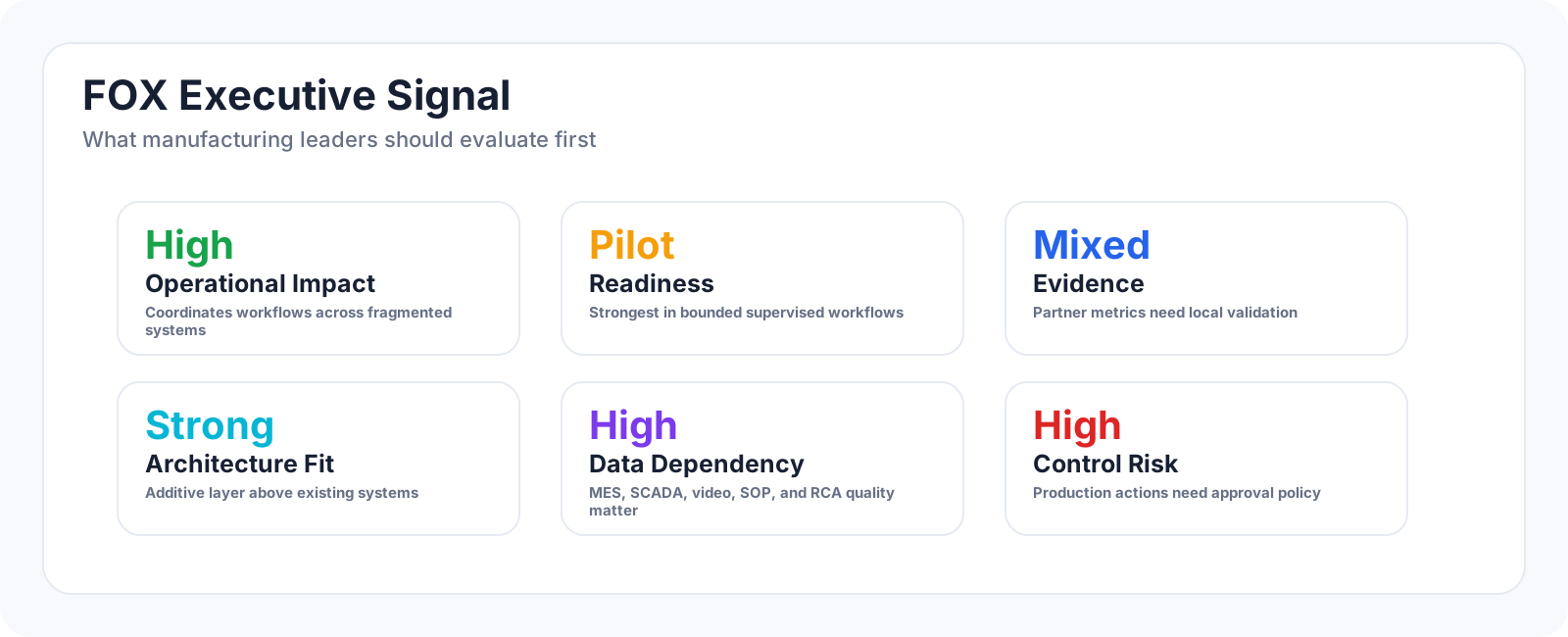
NVIDIA FOX combines the idea of a factory AI brain with a more concrete agentic manufacturing operations architecture. The practical value is not a single model or dashboard; it is a governed orchestration layer that reads factory context, dispatches specialized agents, maintains auditability, and keeps high-risk production actions behind policy and human approval. The decision for manufacturing leaders is whether FOX should be evaluated as an additive Level 3.5 operating layer above existing MES/MOM, SCADA, vision, logistics, quality, and maintenance systems.
1. Executive Summary
FOX should be read as a reference architecture for plant-wide industrial agents. The NVIDIA blog frames FOX as a factory operations blueprint where a factory manager agent coordinates specialized agents for root-cause analysis, SOP verification, visual inspection, material flow, energy, safety, and operational-twin review. The technical deep dive extends that idea into a MOM-adjacent architecture: a central orchestrator that consumes data from MES/MOM, SCADA/HMI, ERP, cameras, robots, SOPs, and maintenance records, then dispatches bounded agents through governed interfaces.
The strongest operational value is cross-system coordination. Quality excursions, inspection drift, SOP deviation review, AGV scheduling, energy optimization, and RCA all cut across systems and teams. FOX is useful because it turns these workflows from manual evidence hunting into structured, policy-bound agent execution. The business case should be measured in cycle-time reduction, engineering review quality, quality escape reduction, model maintenance cost, and operational auditability.
Operating Context
Affected boundary: MES/MOM, SCADA/HMI, quality, vision inspection, logistics, maintenance, energy, safety, and human approval workflows.
Decision Signal
Evaluate FOX as an additive factory operations orchestration layer, not as a replacement for systems of record or production governance.
Readiness and Boundary
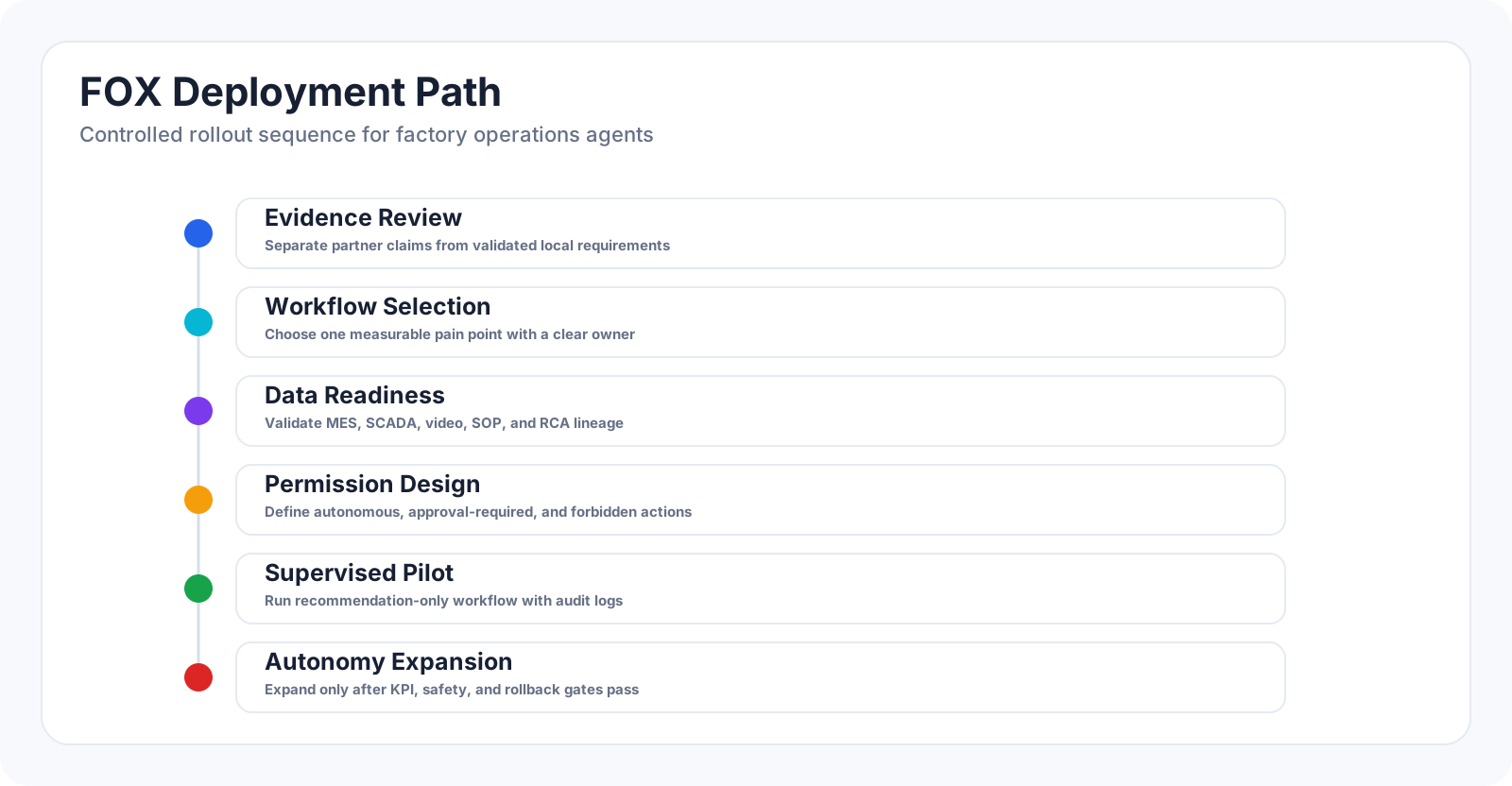
FOX-style pilots are most defensible for monitoring, diagnosis, defect flagging, report generation, model-maintenance recommendations, and supervised workflow coordination. Autonomous line control, work-order pausing, emergency shutdown, and high-value material decisions still require explicit human approval and site-specific validation.
2. Key Points
- FOX reframes factory AI as orchestration, not model deployment: The central pattern is a factory manager agent coordinating specialized agents, machine context, workflow systems, and human decisions.
- The MOM implication is a Level 3.5 operating layer: FOX sits above or beside MES/MOM and SCADA/HMI, reading from systems of record while calling bounded execution interfaces through policy.
- The strongest use cases are cross-functional bottlenecks: RCA, SOP review, visual inspection drift, AGV scheduling, energy optimization, and safety surveillance create value because they require evidence from multiple systems.
- On-prem inference is strategically important: DGX Station GB300 and local NIM endpoints are positioned for sensitive process data, factory latency, export constraints, and offline availability.
- Permission boundaries decide industrial viability: OpenShell-style sandboxing separates autonomous analysis from approval-required actions such as stopping a line, pausing work orders, or triggering emergency shutdown.
- Visual inspection is the densest module: Metropolis VSS, TAO, Cosmos synthetic data, validation, and NIM deployment form a loop for monitoring drift and retraining inspection models.
- Partner metrics are evidence signals, not promises: Reported claims such as FPY improvement, RCA reduction, labor productivity gains, equipment redundancy reduction, and energy savings must be retested against local data and process conditions.
- Brownfield integration is the real adoption gate: OPC-UA servers, MES APIs, camera infrastructure, time-series storage, SOP knowledge, RCA records, naming consistency, and timestamp alignment determine whether the architecture becomes operational.
| Claim | Evidence signal | Confidence | Decision implication |
|---|---|---|---|
| FOX can coordinate many manufacturing sub-agents | Foxconn MoMClaw is described as connecting hundreds of sub-agents to sensors, MES, ERP, and digital systems | Medium | Use as architecture direction; require site architecture review |
| SOP verification can improve operations | Source reports 99% SOP micro-action understanding, FPY +3%, RCA time -80%, labor productivity +15%, equipment failure rate -10% | Medium | Validate on one station before scaling |
| Robot scheduling can reduce redundancy cost | Pegatron case reports equipment redundancy cost -15% | Medium | Good candidate for constrained pilot with AGV telemetry |
| Energy agents can reduce consumption | Advantech case reports energy consumption -10% | Medium | Requires safety bands and facilities approval |
| Synthetic data can reduce visual AI cold start | Roboflow/Corning reports 8 images, mAP 0.95, and strong recall on a hard defect class | Medium | Test against local defect classes before assuming transferability |
| Visual inspection deployment can accelerate | Overview AI/Amphenol reports 300+ products and first inference under 30 minutes | Medium | Useful benchmark for deployment workflow design |
3. Key Technical Details
Factory Manager Agent and MOM-Oriented Architecture
The blog-level message is a factory AI brain; the more useful enterprise interpretation is a factory manager agent. This manager agent does not replace specialized systems. It maintains operational context, understands events across plant systems, dispatches specialized agents, and routes outputs to humans, digital twins, or governed execution interfaces.
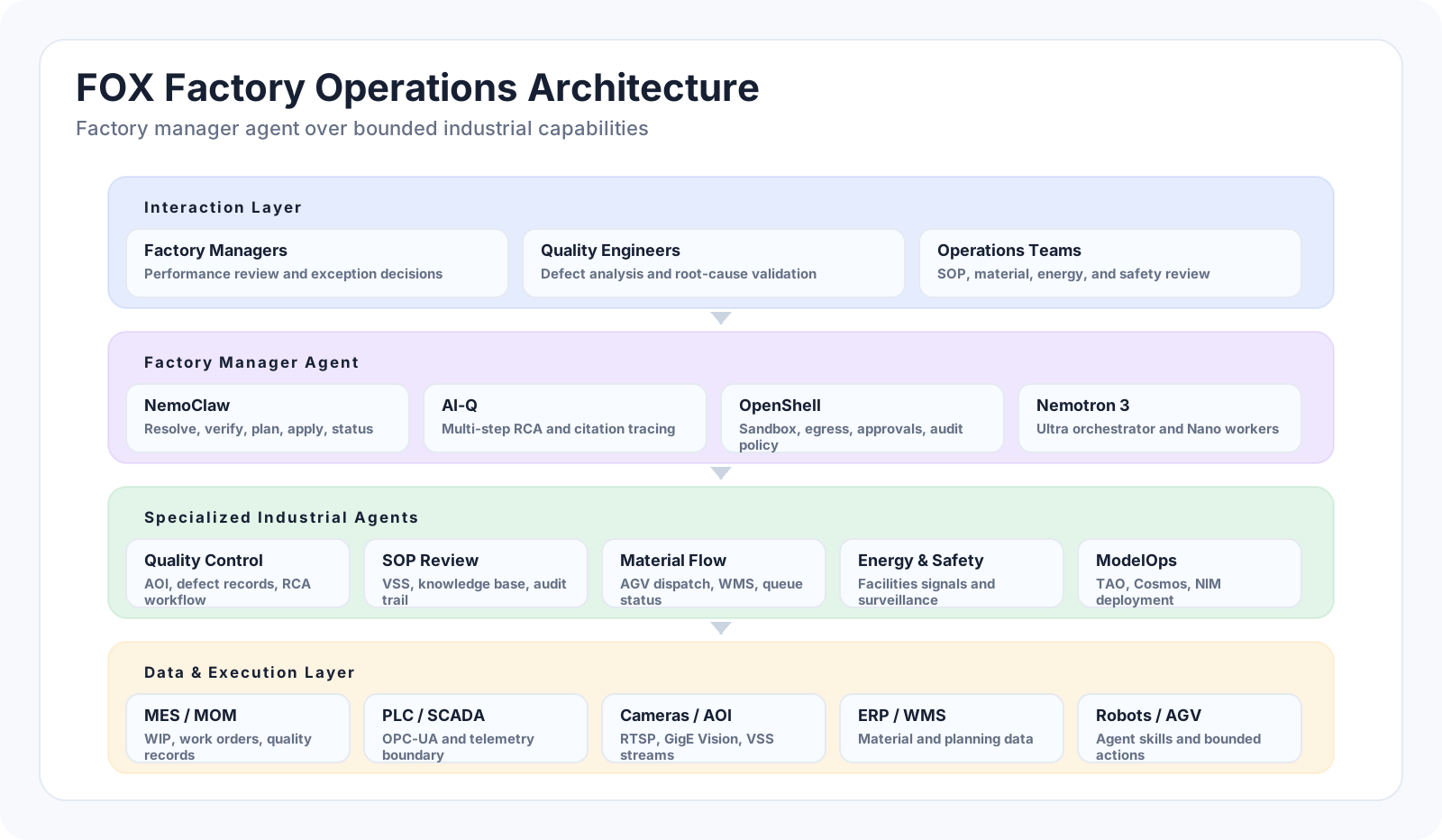
The architecture board shows the enterprise choice clearly: FOX should be implemented as an additive orchestration layer. Existing MES/MOM, ERP, SCADA, QMS, WMS, and vision systems remain the authoritative systems of record. FOX adds reasoning, workflow coordination, evidence routing, and governed execution.
NemoClaw Lifecycle and Multi-Agent Execution
NemoClaw is described as the orchestration framework and runtime foundation. The source presents a five-phase lifecycle: Resolve, Verify, Plan, Apply, and Status. Each phase matters because industrial agents need traceability, permission checks, and reversibility, not only natural-language reasoning.
| Phase | Function | Manufacturing implication |
|---|---|---|
| Resolve | Parse intent and identify tools or agents | Reduces ambiguity in natural-language operations requests |
| Verify | Check permissions against policy | Prevents unauthorized tool calls or high-risk actions |
| Plan | Generate execution paths, including parallel and conditional work | Supports cross-system workflows such as quality plus logistics plus maintenance |
| Apply | Dispatch agents and invoke tools | Turns analysis into bounded operational action |
| Status | Aggregate results and update state | Creates an audit trail for engineering and operations review |
The model routing strategy separates a central Nemotron 3 Ultra orchestrator for complex multi-step reasoning from Nemotron 3 Nano worker agents for lower-latency structured execution. Privacy-sensitive data is claimed to flow through local NIM endpoints on DGX Station.
OpenShell Permission Boundaries
OpenShell is presented as a sandbox and policy boundary that constrains egress, filesystem access, and action execution outside the model process. This is critical because the manufacturing risk is not only a wrong answer; it is an unauthorized tool call, unsafe control action, or silent data exfiltration path.
| Action type | Suggested treatment |
|---|---|
| Data read and analysis | Autonomous |
| Defect flagging and report generation | Autonomous after validation |
| Model retraining trigger | Autonomous only with validation gate |
| Low-value material request | Potentially autonomous |
| High-value material request | Human approval |
| Pause work order or slow line | Human approval |
| Stop line or emergency shutdown | Human approval |
AI-Q Root-Cause Reasoning Workflow
AI-Q is described as the multi-step reasoning backbone, implemented with a LangGraph state machine, LangChain DeepAgents, and NeMo Agent Toolkit. The example RCA workflow starts with a PCB bridging defect threshold breach, retrieves sensor data, cross-references MES material-change logs, searches historical defects, checks maintenance logs, and produces a structured root-cause report.
Visual Inspection Retraining Loop
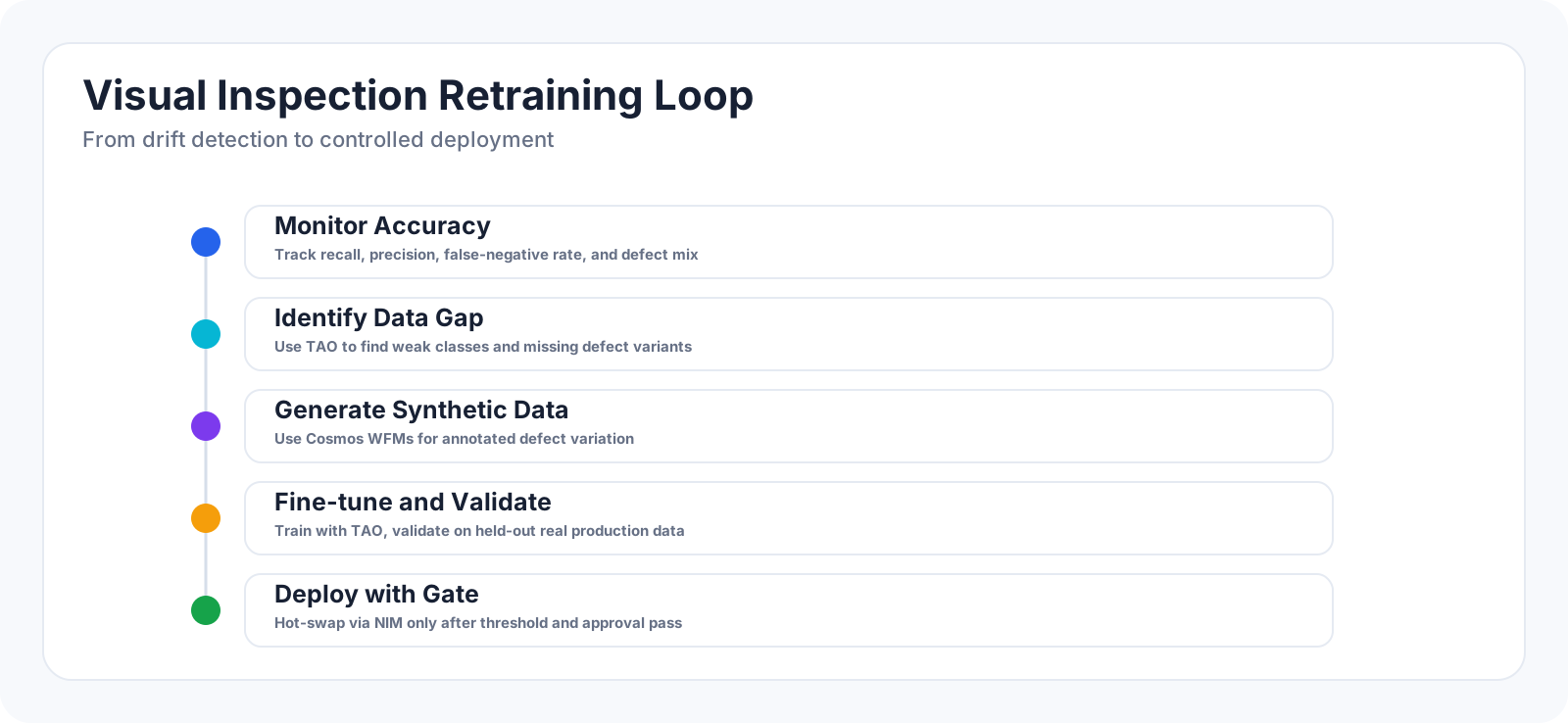
Visual inspection is the highest-density FOX module because it connects business value, scarce defect samples, model drift, and manufacturing ML operations. The loop monitors precision and recall in Metropolis VSS, triggers on drift or false-negative thresholds, uses TAO to identify weak classes, uses Cosmos WFMs to generate synthetic annotated defect images, fine-tunes and validates with TAO, then deploys via NIM hot-swap only after the validation gate passes.
Enterprise Adoption Lens
FOX adoption should start where business pain, data availability, and approval boundaries overlap. A good pilot is recommendation-only RCA, SOP deviation review, inspection drift remediation, or AGV scheduling under constrained policy. A weak pilot is broad factory autonomy without a clear rollback path, data lineage, or ownership model.
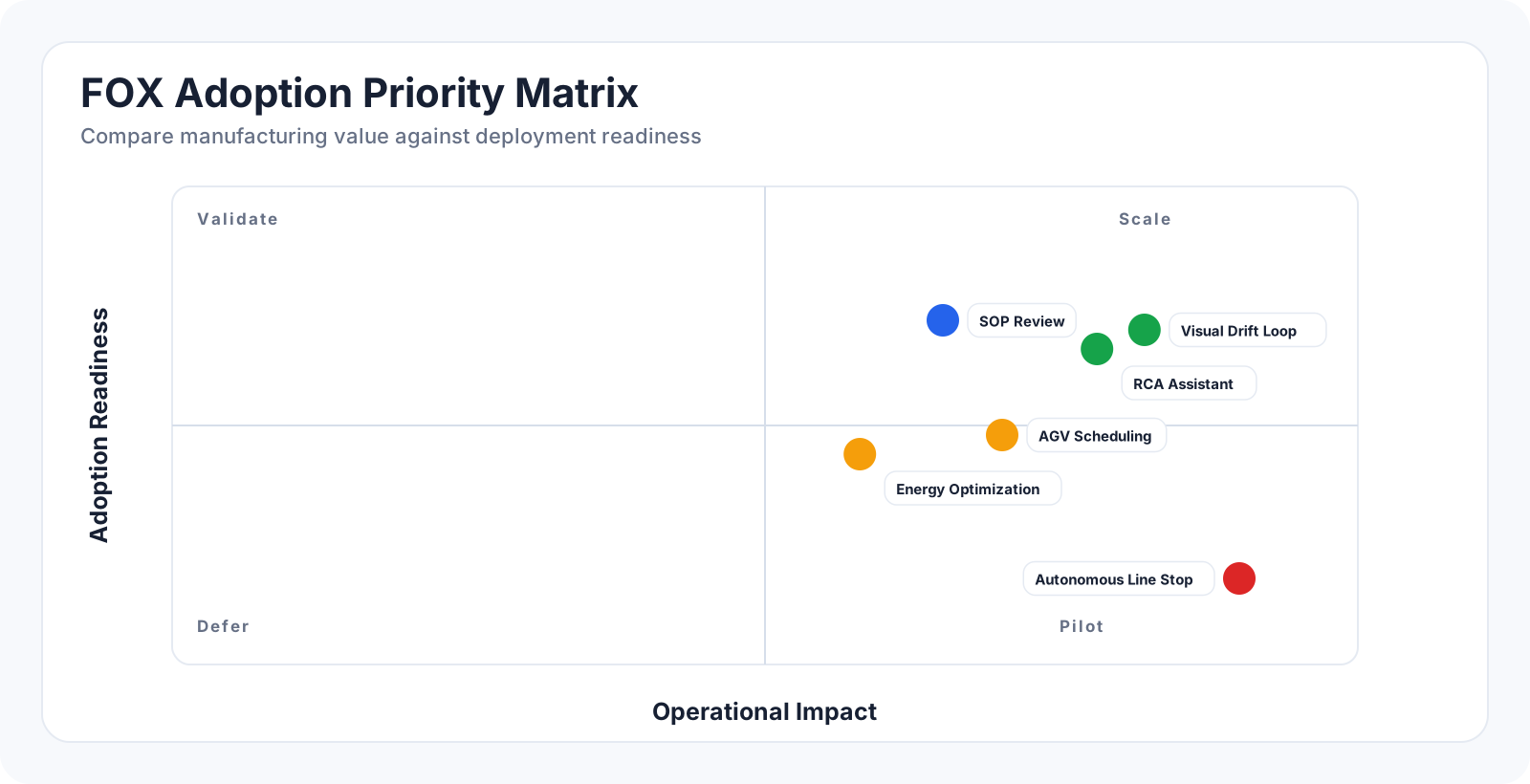
The matrix makes the operating priority explicit: start with high-value but supervised workflows, then expand autonomy only after the site proves data quality, policy enforcement, operator trust, and measurable KPI improvement.
Evidence, Performance, and Constraints
The source makes several hardware and deployment claims. DGX Station GB300 is described with 748 GB unified memory, 20 PFLOPS FP4, NVLink-C2C interconnect, and enough local capacity for approximately 1T-parameter inference. The manufacturing argument is that large local memory can hold live sensor streams, historical quality records, SOPs, and maintenance manuals in a single reasoning environment, reducing reliance on external vector databases.
The main constraints are brownfield rather than model-only: poor MES semantics, missing historical records, inconsistent equipment naming, weak timestamp alignment, insufficient camera quality, unclear approval policy, unresolved OT/IT segmentation, and integration debt around legacy PLC or MES interfaces.
Implementation Notes
Implementation should be treated as an industrial control and data-integration program, not only an AI model rollout. Real-time data requires OPC-UA servers or protocol gateways for legacy PLCs, sampling rates around at least 1 Hz for critical quality parameters, and time-series storage such as InfluxDB or TimescaleDB. MES integration requires APIs for work orders, WIP, process parameters, and defect writes; legacy systems may need ETL, direct database access, or middleware. Visual data requires camera coverage at critical stations, recommended 2MP/30fps cameras, and 10GbE networking for concurrent streams. SOPs, equipment manuals, and historical RCA reports need to be digitized and searchable.
4. My Take
FOX is a credible architecture direction because it treats manufacturing agents as bounded operators inside existing systems, not as replacements for MES, engineering judgment, or production governance. The practical opportunity is to shorten diagnosis, evidence routing, and inspection-model maintenance while keeping humans in control of production-risk decisions.
- My priority: Start with one high-friction workflow such as visual inspection drift, SOP deviation review, or quality root-cause analysis, then measure cycle time, escape rate, and engineering review quality.
- I would avoid: Treating the factory AI brain narrative as permission for broad autonomy before data lineage, rollback, and approval behavior are proven.
- Validation required: Prove data integration, permission enforcement, latency, model accuracy, audit logs, rollback, and human approval behavior under realistic failure cases.
References
- NVIDIA Factory Operations Blueprint Gives Factories a New AI Brain
- Local technical source:
file:///Users/deanlu/Documents/github/ai-pulse-scout/nvidia-fox-blueprint-en.html - NVIDIA NemoClaw
- NemoClaw GitHub
- Metropolis VSS Blueprint
- TAO Toolkit
- Manufacturing AI Agent Architecture and Readiness
- Physical AI & Industrial Manufacturing
- Core AI Platforms & Agents